

The Stolen Generation
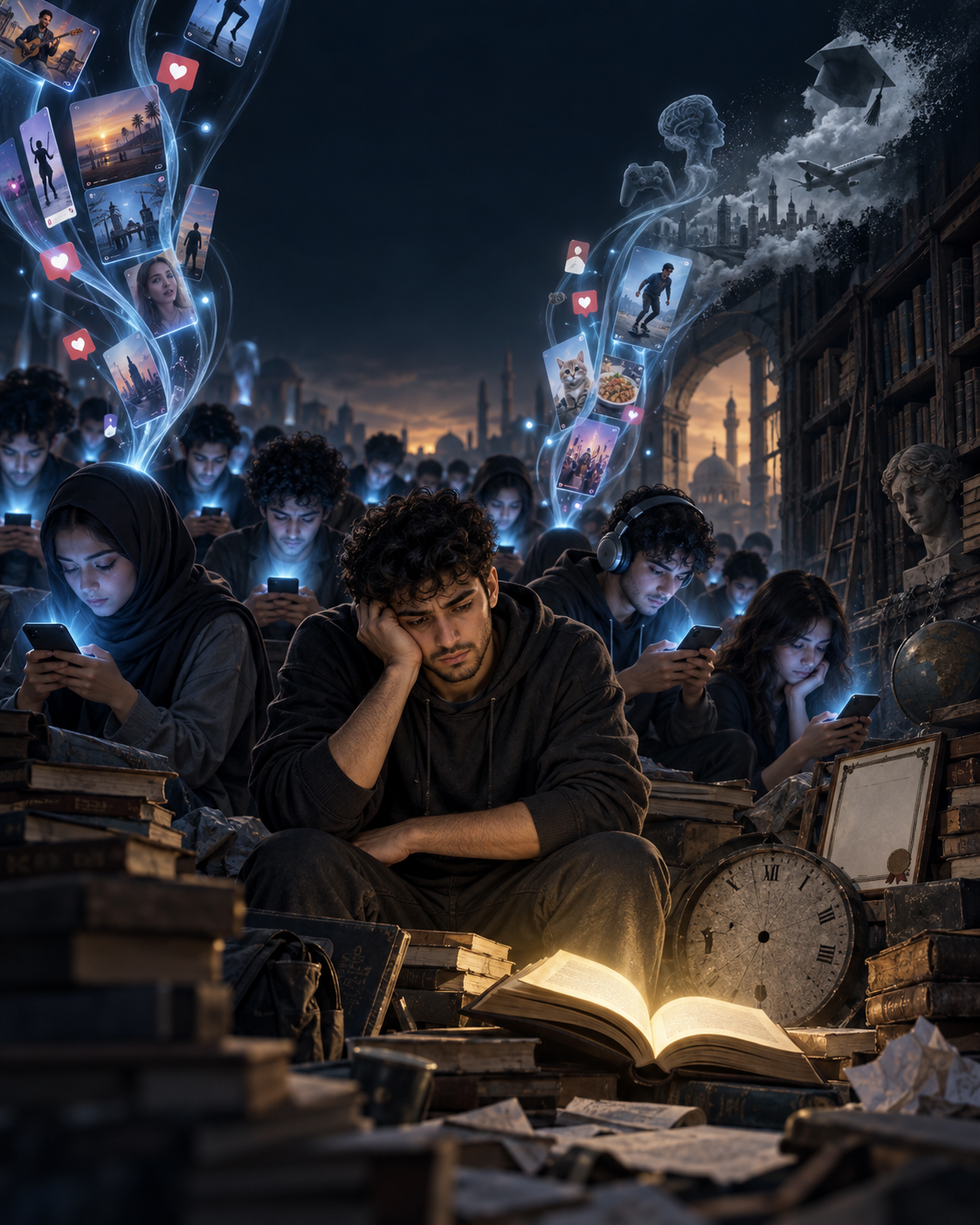


If you look around and reflect on what is happening, you will realize that we are not merely living in the age of digital advancement, but in an age in which the lives of an entire generation have been stolen, its energy drained, and its awareness gradually emptied. Many of its young people now know everything about celebrities and trends, yet know far too little about themselves, their countries, or their own futures.
This is the stolen generation: a generation from which neither money nor land has been taken, but something far more precious—time, attention, the ability to think, the desire to learn, and the passion to build a meaningful future.
Technology itself is not the culprit. Technology is simply a tool: it can open the doors of knowledge, just as it can become a means of wasting an entire lifetime. The real problem lies in minds that have chosen triviality, systems that have allowed empty content to dominate, and societies that have begun to reward the frivolous with fame, give the ignorant a platform, and grant undeserved value to those who merely make the most noise.
Entire generations have become intellectually hollowed out. A young person may obtain a high school certificate, move on to university, and eventually graduate holding a degree while the knowledge actually acquired may not be worth the ink with which that degree was printed, nor even the weight of the paper on which it was written.
Passing an examination does not necessarily mean that education has succeeded. Obtaining a certificate does not mean possessing knowledge, and graduation alone does not create an educated person or someone truly prepared for life and work.
For some, the academic certificate has become little more than an ornament of social status rather than evidence of knowledge and competence. A student may spend many years in education and still emerge unable to express an idea properly, discuss an issue intelligently, analyze information, or make an independent decision. They memorize in order to pass, then forget what they memorized because they were never taught how to think; they were merely taught how to get through an examination.
More dangerously, a segment of young people has become intellectually superficial. They live on headlines without reading the details, pass judgments without knowledge, and repeat what they hear without asking questions or verifying facts.
They want quick answers, quick success, quick fame, and quick wealth, yet they are unwilling to pay the true price of knowledge: time, effort, discipline, patience, and perseverance.
Short-form videos have trained many people to become impatient with every deep idea. The book has become too long, the article exhausting, the lecture boring, and serious discussion an unbearable burden.
Some young people can no longer concentrate for even a few minutes, yet they are capable of spending hours endlessly scrolling through clips that add absolutely nothing to their minds.
Electronic communication, which was supposed to bring people closer together, has in many cases turned into constant noise, superficial relationships, and an overwhelming digital presence accompanied by a painful absence of genuine human connection.
We have become more connected to devices and less connected to people. We follow the lives and news of strangers while sometimes remaining unaware of the pain of those closest to us.
The problem is no longer limited to the content itself. It has extended to meaningless comments, shallow interactions, and opinions written without knowledge or responsibility. It is as though some people are not searching for an idea to understand, but merely for a space in which to unload their ignorance and emotions. They then imagine that simply leaving a comment gives them value, and that raising their voice can compensate for the absence of thought.
The problem is not that people disagree. Difference is evidence of life, diversity, and intellectual vitality. The disaster begins when ignorance is transformed into opinion, mockery into a language, vulgarity into interaction, and noise into a substitute for thought.
Giving everyone the opportunity to speak does not mean that everything being said deserves to be heard, and owning a social media account does not mean possessing knowledge.
We are facing a generation that has access to tools of knowledge that no previous generation ever possessed, yet at the same time it confronts perhaps the most powerful machinery ever created for distracting the mind and stealing human attention.
The libraries of the world are literally within reach, yet a person may deliberately choose their most trivial content. A young person can learn a new language, profession, skill, or field of knowledge, yet may instead spend countless hours following the lives of others.
Nevertheless, it would be unfair to place the entire responsibility on young people themselves.
There is an educational system that has relied heavily on memorization while neglecting critical thinking. There are families that became preoccupied with providing material possessions while forgetting to build the human being. There is media that has turned triviality into heroism, and there are societies that have exaggerated the importance of certificates while neglecting the true value of knowledge, work, competence, and skill.
Saving this generation does not require banning technology. It requires teaching young people how to use it.
It does not require filling their memories with ever more curricula, but training them to think, question, research, analyze, and create.
We need an education system that restores the value of knowledge, families that reclaim their educational role, media that respects the human mind, and genuine role models who prove to young people that real success is built through effort and achievement—not through the number of followers on a screen.
The stolen generation is not necessarily a lost generation. But it is a generation whose mind is being fought over by countless forces.
If we fail to restore its awareness today, tomorrow it may hold higher degrees and possess smarter devices, yet become less capable of thinking independently and shaping its own future.
Not everyone who holds a degree is educated.
Not everyone who is famous has value.
And not everything that fills our time deserves to fill our lives.
The tragedy is not that the world is developing rapidly.
The tragedy is that the devices around us continue to evolve, while the human being within us continues to decline